

A Japandi Cabin: A Serene Mountain Retreat in Warm Stone, Rust and Muted Sage
The word cabin comes preloaded. Say it, and most people picture the same room. Dark stained logs, a plaid throw, antlers over a stone fireplace, everything heavy and dim.
It is cozy. However, it is also exhausting to actually live in for a week.
This is the other version. Same remote-mountain fantasy, but built from pale warm stone, soft plaster and unfinished wood instead of dark timber. A quiet Asian influence runs through the lanterns, the low furniture and the detailing. These images were created using AI, and together they make the case for the cabin as a place to decompress rather than perform ruggedness.

The palette: warm stone with rust running through it
The base here is a pale, sandy, warm stone. Not gray, not white, not cold in any direction. Think limewashed plaster, unpolished travertine, oatmeal, bone, greige and warm sand.
Two accents then run through it at very low volume. Rust shows up as clay, terracotta and sienna in the murals and textiles. Meanwhile, a sage green sits so muted it reads closer to eucalyptus or celadon than anything you would call green.
Proportion is the whole trick. If you turned the rust up twenty percent, this would tip straight into Southwestern. Turn the sage up instead, and it becomes a green room.
Held where they are, both colors act as warmth inside a neutral rather than as colors in their own right. As a result, the space asks nothing of you when you walk into it.
- Test your wall color at three times of day before committing. Warm neutrals shift dramatically between morning and lamplight.
- Keep every white in the house on the warm side. One cool white will read as a mistake against limewash.
- Buy your rust and sage in textiles first, not paint. Fabric is cheap to change if the proportion turns out wrong.
One accent wall mural, and nothing else fighting it
Every room here has exactly one big move, and it is almost always a wall. In the living room, a full ink-wash landscape sits behind the seating, complete with mountains, mist and a faint sun disc. Then the room does essentially nothing else.
The sofa is cream. The table is a plain wood block. No gallery wall appears, no patterned rug, no second statement.
This is the most important rule in the look, and it is the one people break. A mural that size carries a very large amount of visual information. Pair it with a patterned rug and a bold light fixture, and three things compete at once.
That is how a calm room turns busy without anyone being able to say why. One mural, one quiet room. Those are the terms.
- Choose your wall before you choose your furniture. The mural sets the palette, so everything else has to answer to it.
- Keep the rug plain when the wall is patterned. If you want a patterned rug instead, the wall has to go quiet.
- Hang nothing else on the mural wall. No shelves, no sconces, no art layered on top.
Two kitchens, two ways to use stone

The first kitchen keeps the island pale and lets the mural behind it carry the room. That stone is soft and barely veined, while the cabinetry stays a warm mid-tone wood. Only one metal appears, an unlacquered brass tap that will keep dulling down over time.
Nothing here is polished. That matters more than it sounds.

The second kitchen flips the arrangement. Here the island itself is the event, a heavily veined green stone with rust running through it. Meanwhile, the walls step back to plain plaster.
Both work, but they answer different rooms. If your kitchen already has a good wall to look at, keep the island quiet. If it does not, put the drama into the stone and let the walls disappear.
- Specify unlacquered brass if you want the patina. Lacquered brass stays shiny forever and fights this palette.
- Choose your island stone in person. Veining varies enormously slab to slab, and photos flatten it.
- Clear the counters and keep them clear. Warm minimalism is an editing discipline more than a decorating style.
The dining room: a low table and one paper lantern

This dining room shows the Asian influence most plainly. An oversized paper pendant hangs low over a plain wood table, while a rust runner supplies the only color in the room.
That single pendant does the work a chandelier would do in a traditional cabin. Because it is matte paper rather than metal or glass, however, it diffuses light instead of throwing it around.
- Hang it lower than feels correct, roughly thirty inches above the table.
- Go one size up from what the showroom recommends. Paper pendants read smaller once they are actually installed.
- Skip the overhead downlights. A paper pendant plus wall lighting is enough, and mixing the two flattens the room.
Three bedrooms, each with a wall to look at

Bedrooms are where this palette earns its keep, because the same principle applies with even less competition. Only the wall behind the bed gets decorated. Everything else stays soft and low in contrast.

The second bedroom trades the landscape for a single amber sun disc. This version is far easier to execute at home. A large circle of warm color on plaster needs paint and a steady hand, whereas a full mountain landscape realistically means wallpaper or a commissioned artist.
It also pairs beautifully with a separate window-side chair. That chair is the detail turning a bedroom into a retreat.

The third bedroom is the quietest. Muted sage bedding, warm plaster, and a soft abstract canvas instead of a mural. If the murals feel like more commitment than you want, this room proves the palette still holds without one.
- Paint a sun disc rather than papering a landscape if this is your first attempt. The payoff is similar and the risk is far lower.
- Add a chair by the window even in a small room. A second place to sit is what separates a retreat from a bedroom.
- Keep bedding within two shades of the wall. High contrast between bed and wall breaks the calm immediately.
For a moodier take on the same restraint, the Japandi home in burgundy pushes this exact structure into much deeper color.
The bathrooms: weathered wood and a real reflection
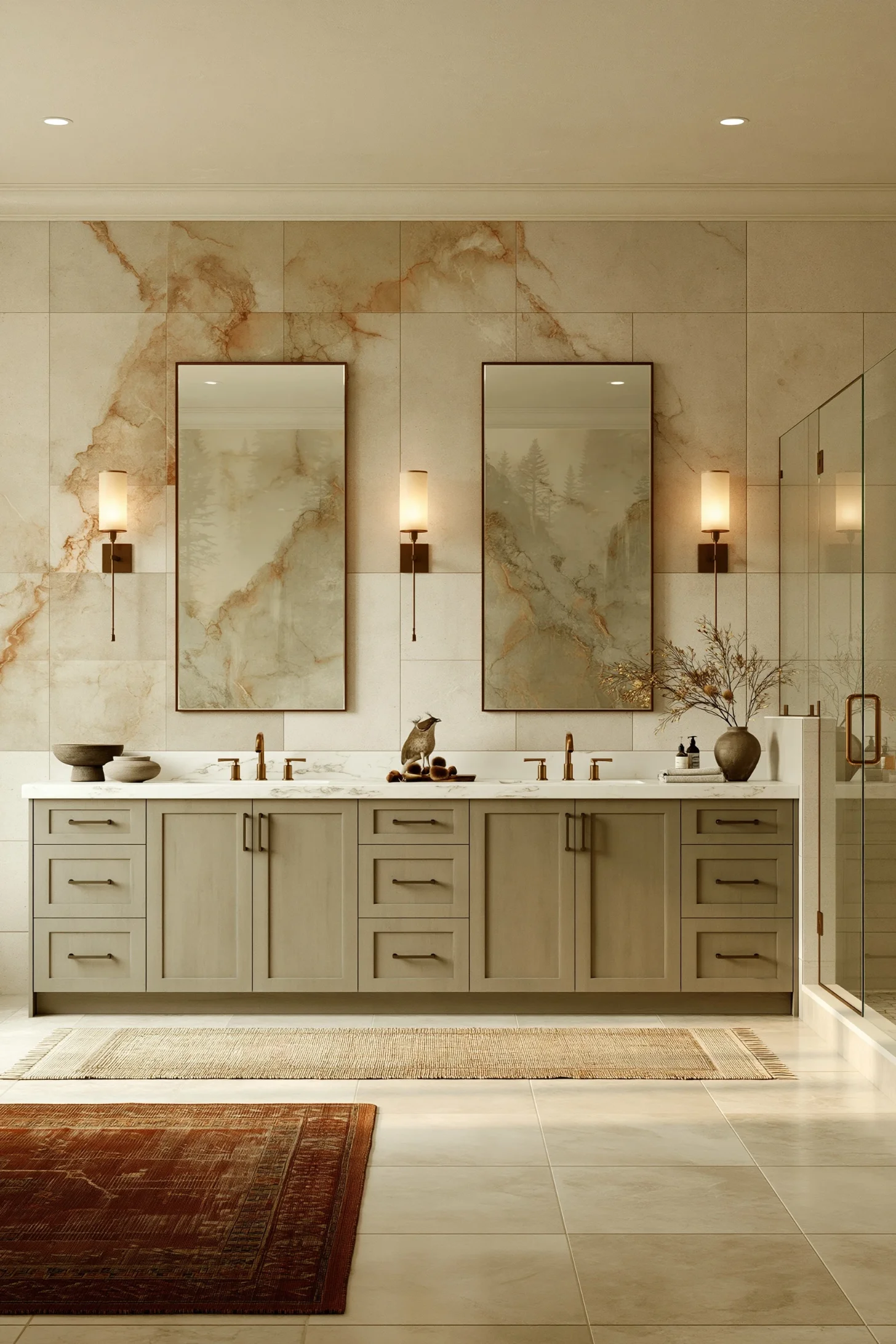
The main bathroom pairs a weathered wood double vanity with two separate mirrors rather than one long one. Because of this, the wall never reads like a hotel bank of sinks.
That rust patterned rug supplies the only pattern and the only saturated color. Notably, it sits on the floor where nothing at eye level has to compete with it.
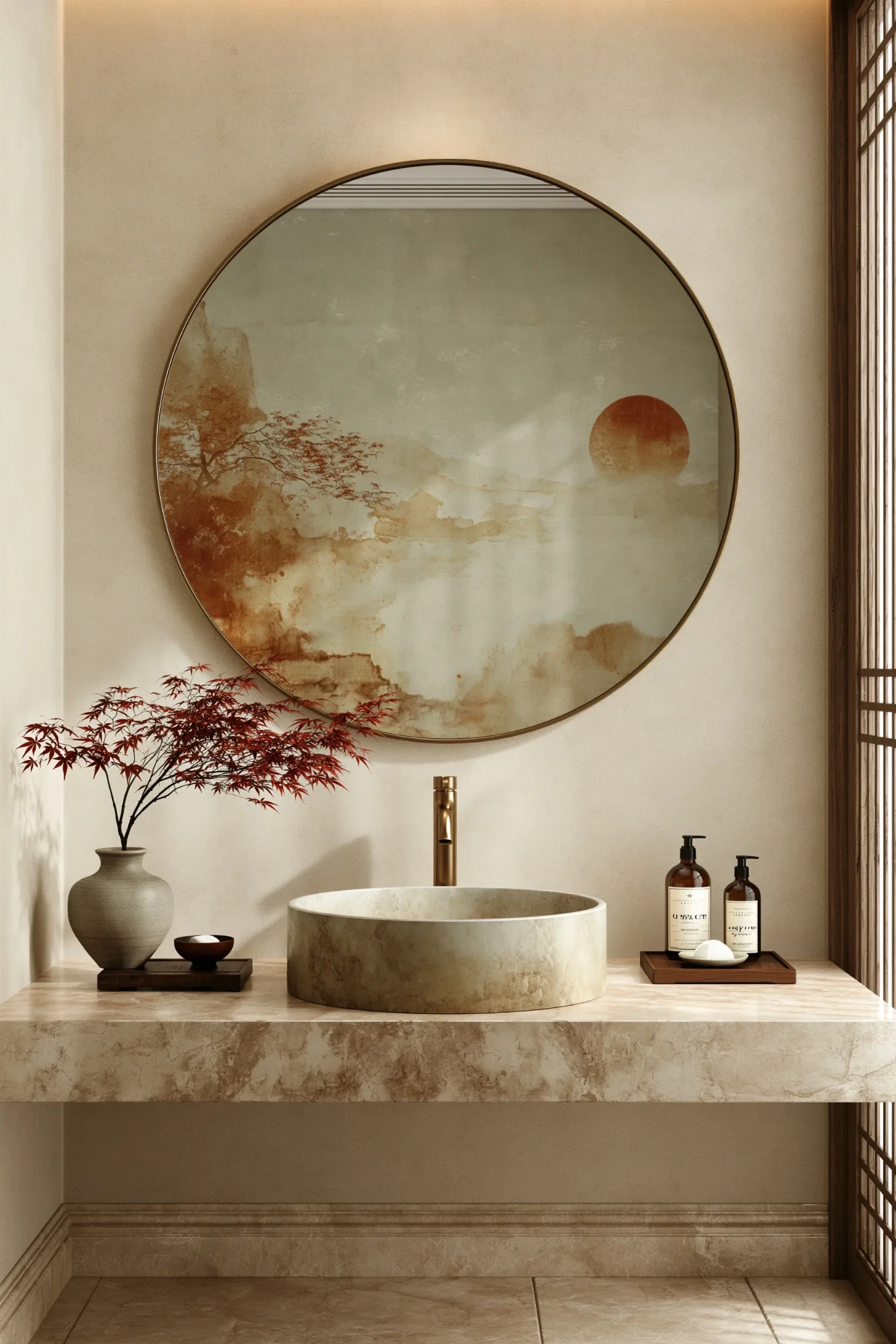
A powder room is the one place worth being less restrained than the rest of the house. It is small, nobody lingers, and no furniture competes with the walls.
A carved stone basin, a round mirror and a full landscape mural make that room a memorable thirty seconds. Better still, it costs almost nothing in square footage.
- Use two mirrors over a double vanity, not one long one. Two reads residential; one reads commercial.
- Put your boldest idea in the powder room. Low risk, high payoff, easy to change later.
- Keep the pattern on the floor in wet rooms. Rugs and tile take pattern well; walls at eye level do not.
Why this warm minimalist cabin feels so calm
Calm usually gets described as an absence. In reality, it is a set of decisions, and three of them are doing the work here.
First, the contrast range stays narrow. No true black and no true white appear anywhere, so your eye never makes a hard adjustment moving between surfaces.
Second, saturation stays low while temperature stays warm. That combination reads restful instead of cold or clinical.
Third, pattern concentrates in exactly one place per room. Consequently, there is always somewhere for your eye to rest.
That last point gets underestimated most. A room with a little pattern everywhere tires you faster than a room with a lot of pattern in one spot, because the first gives you nowhere to look away to. For the same logic in a softer color story, the muted sage and soft purple home tour runs on this structure too.
If you are starting from an ordinary room, work in this order. Warm the walls first, then subtract, then add exactly one thing back.
Warming the walls means a limewash or plaster finish in a sandy off-white. That single change delivers more than any furniture purchase, and it costs less. Subtracting means clearing surfaces and removing the second and third statement pieces. Adding one thing back means picking your wall and letting it be the only loud thing in the room.
Do those three in order, and the mountain-getaway feeling arrives well before the mountains do.
Save your favorite rooms from this post to Pinterest so you have them when you start planning your own space.


